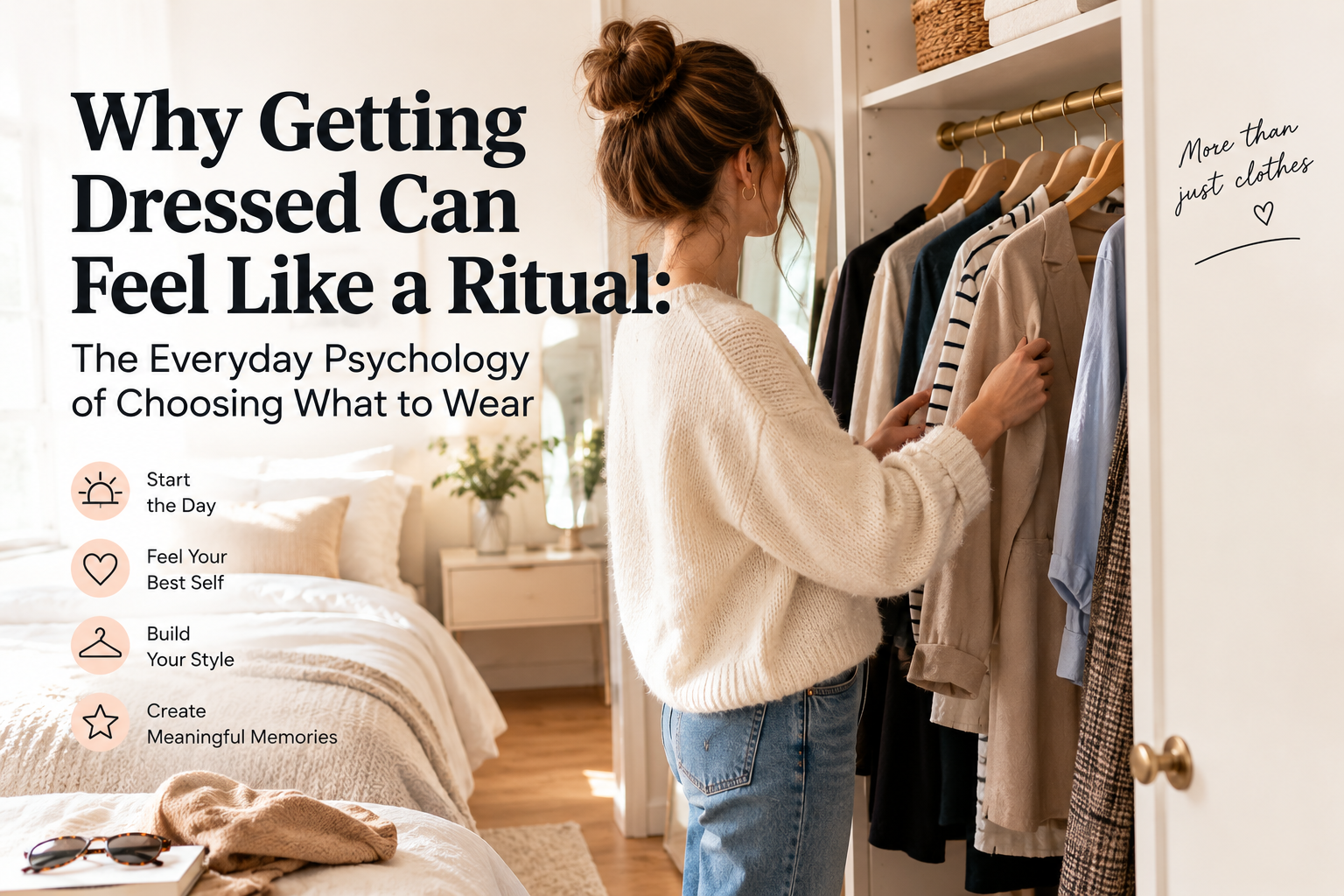
Getting dressed is something most people do without thinking about it.
You wake up, open your closet, choose something, get dressed, and move on with your day.
Yet for many people, the process is more than a simple practical task. Certain clothes are saved for special occasions. Favorite outfits are worn on important days. Some people always get dressed in the same order, while others have a particular outfit they reach for whenever they want to feel confident, relaxed, creative, or prepared.
In other words, getting dressed can become a personal ritual.
It may look ordinary from the outside, but these small routines can give structure to everyday life and help create a sense of transition between different parts of the day.
So why does choosing what to wear sometimes feel surprisingly meaningful?
1. Getting Dressed Marks the Start of the Day
The transition from sleeping to being awake is gradual.
You may check your phone, make coffee, look outside, or think about everything you need to accomplish.
Getting dressed is one of the clearest physical signals that the day has begun.
Changing clothes creates a visible difference between one state and another.
Pajamas belong to rest.
Day clothes belong to activity.
Workwear belongs to work.
An evening outfit can signal that the day's responsibilities are finished.
This simple change can make clothing part of our daily rhythm.
It is not necessarily about fashion. It is about transition.
The clothes we put on can help separate one part of life from another.
2. We Often Dress for the Person We Expect to Be That Day
One interesting thing about getting dressed is that we often choose clothes according to what we expect the day to require.
A quiet day at home may call for something comfortable.
A meeting may encourage something more structured.
A celebration may make us choose something more expressive.
A long day outside may influence what feels practical.
The outfit becomes a response to the situation ahead.
But sometimes the relationship works in the opposite direction.
Instead of choosing clothes because of how we expect to feel, we choose clothes because of how we want to feel.
That distinction is important.
You might choose a polished outfit because you want to feel more organized.
You might choose a favorite color because you want something familiar.
You might wear something unusual because you want the day to feel different.
Clothing can therefore be both a response to the day and a way of setting the tone for it.
3. Why We Have “Default” Outfits
Almost everyone has some version of a default outfit.
It is the combination that requires very little thought.
Perhaps it is a particular pair of trousers with a simple top. Maybe it is a favorite dress, a familiar jacket, or an easy combination of pieces that always seems to work.
The advantage of a default outfit is obvious:
It removes a decision.
Instead of standing in front of the closet asking what to wear, you already know what works.
This can be especially useful on busy mornings.
A reliable outfit does not have to be boring. In fact, some of the most personal styles are built around a small number of familiar combinations.
The goal is not endless variety.
Sometimes the goal is knowing exactly what feels right.
4. Repetition Can Create Personal Style
Fashion is often associated with novelty.
New collections appear.
New colors become popular.
New silhouettes enter stores.
But personal style often develops through repetition rather than constant change.
Wearing similar shapes, proportions, or combinations over time helps create a recognizable visual identity.
Eventually, certain choices become associated with you.
Maybe people expect you to wear clean, simple outfits.
Maybe you are known for expressive accessories.
Maybe your wardrobe is built around relaxed silhouettes.
Maybe you prefer dressing in a way that feels understated.
These patterns do not necessarily come from a deliberate decision to create a personal brand.
They can develop naturally through repeated choices.
Personal style is often less about discovering something completely new and more about noticing what you repeatedly choose.
5. Some Clothes Become Connected to Specific Memories
Clothing can also become connected to important moments.
A particular outfit might remind someone of a graduation.
Another might be associated with a first trip to a new city.
A coat might bring back memories of a winter spent somewhere meaningful.
A dress might immediately remind someone of a celebration.
The interesting part is that the clothing itself does not have to be extraordinary.
Sometimes the most ordinary pieces become the strongest reminders.
This happens because objects can become associated with experiences.
Years later, seeing or wearing a familiar item can bring back a surprisingly detailed memory of where you were, who you were with, or what life felt like at the time.
The clothing becomes a small physical connection to a previous version of your life.
6. Why Special Clothes Sometimes Stay in the Closet
There is another interesting side to clothing rituals: saving things for later.
People sometimes own clothes they rarely wear because they are waiting for the right occasion.
A beautiful outfit may remain untouched because an ordinary Tuesday does not seem special enough.
But what makes an occasion special?
Sometimes, the event itself.
Sometimes, our expectations.
And sometimes, simply the decision to treat an ordinary day differently.
There is something appealing about having clothes reserved for meaningful moments. But there can also be value in allowing favorite pieces to become part of everyday life.
A special outfit does not necessarily become less special because it is worn more often.
Sometimes repeated use gives it a richer story.
7. The Order of Getting Dressed Can Become Automatic
Many people develop a specific sequence without realizing it.
Perhaps they choose clothes first and accessories last.
Perhaps they get dressed completely before doing their hair.
Perhaps they always prepare tomorrow's outfit at night.
Perhaps they put on the same type of item first every morning.
These habits are small, but repeated actions often become automatic.
That is one reason routines can feel comforting.
You do not have to consciously decide every step.
The process simply happens.
In a world filled with decisions, repetitive routines can provide a small area where everything feels predictable.
Getting dressed can become one of those moments.
8. Your Closet Can Reflect Different Versions of You
A wardrobe rarely represents only one identity.
Most people have different sides of themselves.
There may be clothes for work, weekends, travel, social events, relaxing, exercising, celebrations, and completely ordinary days.
These categories do not necessarily contradict one another.
They reflect the fact that people occupy different roles and environments.
The clothes that feel appropriate for one situation may feel completely wrong in another.
That does not mean personal style is inconsistent.
It can mean that personal style is flexible.
Your wardrobe is not necessarily a single statement about who you are.
It can be a collection of different ways you express yourself.
9. Why Comfort Is About More Than Physical Feeling
When people talk about comfortable clothing, they often mean physical comfort.
Soft fabric.
Relaxed shapes.
Lightweight materials.
Easy movement.
But comfort can also be psychological.
An outfit can feel comfortable because it feels familiar.
You know how it looks.
You know how it moves.
You know how you feel when you wear it.
There is less uncertainty.
This explains why people sometimes return to the same outfit even when they own many other choices.
The appeal may not be that the outfit is objectively the most comfortable.
It may simply feel dependable.
10. Getting Dressed Can Create a Boundary Between Work and Home
Modern life has blurred many traditional boundaries.
People work remotely.
They answer messages outside office hours.
They carry work in their pockets.
The physical distance between professional and personal life can become very small.
Clothing can sometimes help recreate that boundary.
Changing clothes at the end of the workday can become a symbolic way of saying:
Work is finished.
The day is changing.
Now it is time for something else.
The same principle can work in the morning.
Getting dressed in a deliberate way can signal that leisure time is over and the day is beginning.
The clothing change itself is simple.
The meaning comes from the routine around it.
11. Why We Sometimes Change Outfits More Than Once
Changing clothes during the day is not always necessary.
Yet people often do it.
An outfit may change before going out to dinner.
Work clothes may be replaced after arriving home.
A casual daytime look may become something more polished for an evening event.
These changes create transitions.
They can also make the day feel like it contains separate chapters.
Morning.
Work.
Afternoon.
Evening.
Different clothes can help visually mark those moments.
In that sense, changing outfits is not simply about appearance.
It can be a way of changing the atmosphere around you.
12. Fashion Does Not Always Need to Be About Impressing Other People
One of the most interesting aspects of personal style is that not every clothing choice is made for an audience.
Sometimes people dress for themselves.
They wear a color they personally enjoy.
They choose a particular silhouette because it feels right.
They put effort into an outfit even when they will spend most of the day alone.
They may wear something beautiful simply because they enjoy seeing themselves in it.
This is an important part of fashion that can easily be overlooked.
Clothing can be a private experience.
Not every outfit needs to communicate something to everyone else.
Sometimes it only needs to make sense to the person wearing it.
13. Small Rituals Can Make Ordinary Days Feel Different
There is a reason routines can become meaningful even when they are extremely simple.
They give ordinary actions a little structure.
Choosing an outfit.
Opening the closet.
Putting on a favorite piece.
Checking the final look in a mirror.
Changing into something comfortable at night.
None of these actions is particularly dramatic.
But repeated every day, they become part of the rhythm of life.
And that may be one of the most interesting things about clothing.
Fashion is often discussed through big ideas: trends, designers, collections, celebrities, and major events.
But most fashion happens quietly.
It happens in bedrooms, hallways, bathrooms, offices, elevators, and streets.
It happens when one person decides what to wear on an ordinary morning.
14. Your Style Can Change Without You Noticing
Personal style is not necessarily fixed.
People change jobs.
Move to different places.
Meet new people.
Develop new interests.
Change their daily routines.
Their wardrobes often change along with them.
Sometimes the change is dramatic.
More often, it happens gradually.
One day you realize that the clothes you used to wear constantly no longer feel like you.
Something else now feels more natural.
That does not mean the previous version of your style was wrong.
It simply means your clothing has caught up with a change in your life.
Personal style can therefore be viewed as something that evolves rather than something that needs to be permanently defined.
Final Thoughts
Getting dressed may be one of the most ordinary things we do, but ordinary does not mean meaningless.
The clothes we choose can mark the beginning of a day, create transitions between different activities, reinforce familiar routines, and connect us with memories.
Sometimes we dress for practicality.
Sometimes for other people.
Sometimes for a particular occasion.
And sometimes simply because we want to feel a certain way.
That is what makes the everyday act of getting dressed so interesting.
Fashion does not always need a runway, a trend, or a special event.
Sometimes it is simply the quiet ritual of opening your closet in the morning and deciding who you want to be for the day ahead.